What Is Inside Matcha? A Complete Guide to the Green Powder
Matcha has exploded in popularity over the last decade. But many people still wonder: what is inside matcha that makes it so unique?
Unlike regular green tea, matcha is a Japanese tea made by grinding whole tea leaves into a fine matcha powder. This means when you drink matcha, you consume the entire leaf — not just an infusion of it.
Because of this, matcha contains a remarkable combination of nutrients, antioxidants, amino acids, and natural caffeine.
In this guide, we’ll explore what is inside matcha powder, how it is made, and the key compounds that give matcha its flavour and benefits.
What Is Inside Matcha Powder?
At its core, high-quality matcha contains only one ingredient: finely ground tea leaves known as tencha.
Tencha is a special type of Japanese green tea leaf grown specifically for matcha production. These leaves go through a unique cultivation and processing method before they become the powder we recognise as matcha.
Because the entire leaf is consumed, matcha contains a dense concentration of nutrients compared to regular brewed tea.
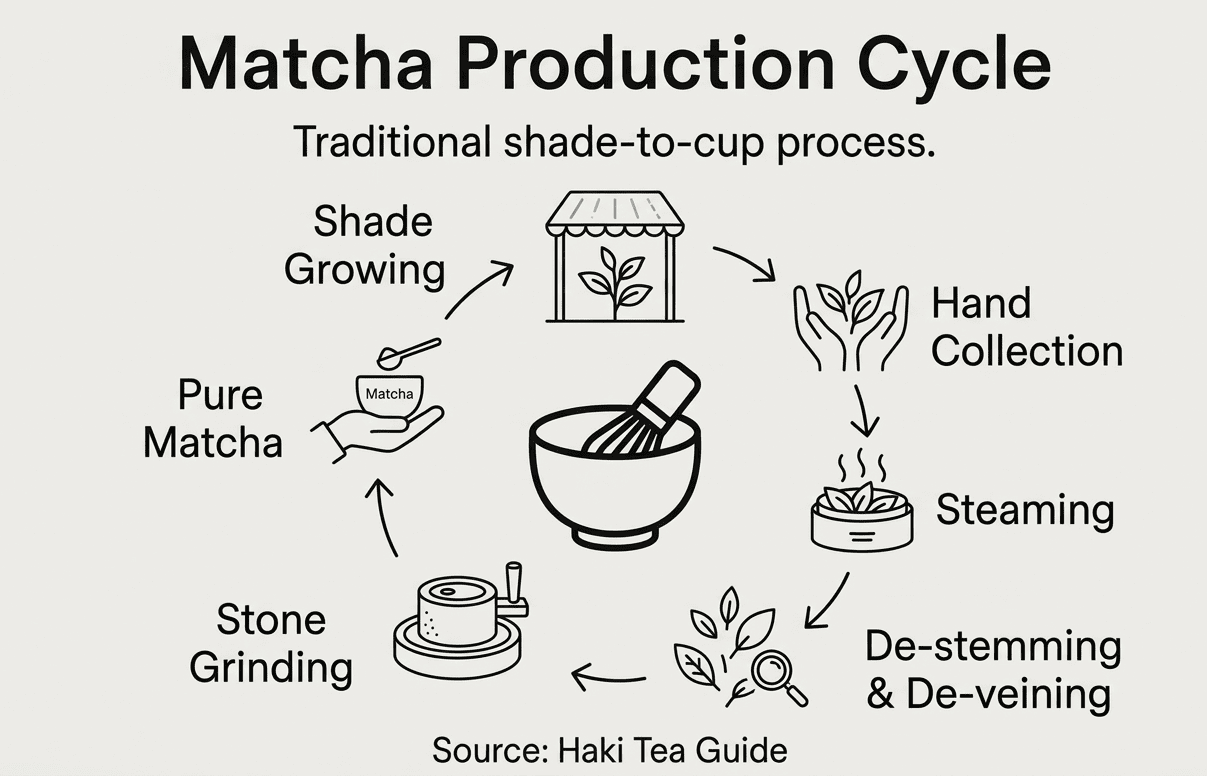
From Tea Leaf to Matcha Powder
Understanding what is inside matcha starts with understanding how it is made.
Key Processes Behind Matcha
| Step | Process | What Happens |
|---|---|---|
| 1 | Shade Growing | Tea plants are covered for several weeks before harvest, increasing chlorophyll and L-theanine levels. |
| 2 | Harvesting | The youngest and most tender leaves are picked in early spring when nutrient levels are highest. |
| 3 | Steaming | Fresh leaves are quickly steamed to stop oxidation and preserve their bright green colour. |
| 4 | Stem & Vein Removal | Stems and tougher veins are removed, leaving soft leaf material called tencha. |
| 5 | Stone Grinding | Tencha leaves are slowly ground into an ultra-fine powder using traditional stone mills. |
1. Shade Growing
About three weeks before harvest, tea plants are covered with shade cloths.
Reducing sunlight forces the plants to produce:
More chlorophyll (giving matcha its bright green colour)
Higher levels of L-theanine, an amino acid responsible for matcha’s smooth, umami flavour
This shading process is one of the most important steps in matcha production.
2. Harvesting
Matcha leaves are usually harvested in early spring.
Farmers typically select the youngest and most tender leaves, which contain the highest concentration of nutrients and amino acids.
3. Steaming
Immediately after harvest, the leaves are steamed to stop oxidation.
This prevents the leaves from turning brown (like black tea) and helps preserve:
Their bright green colour
Their fresh flavour
Their nutritional content
4. Removing Stems and Veins
The steamed leaves are then dried and separated from their stems and veins.
The remaining soft leaf material is called tencha.
Removing these tougher parts improves the flavour and allows the leaves to be ground into an ultra-fine powder.
5. Stone Grinding
Finally, tencha is slowly ground into matcha using traditional granite stone mills.
This process creates an incredibly fine powder — often around 5–10 microns in size — which gives matcha its smooth texture and ability to blend easily into drinks.
The Key Compounds Inside Matcha
Matcha contains several important natural compounds that contribute to its flavour, colour, and potential health benefits. The table below summarises the most important components.
| Compound | What It Is | Why It Matters |
|---|---|---|
| Catechins (EGCG) | Powerful antioxidants naturally found in tea leaves | Help protect cells from oxidative stress |
| L-Theanine | Amino acid unique to tea plants | Promotes calm focus and balances caffeine |
| Caffeine | Natural stimulant present in tea leaves | Provides steady and sustained energy |
| Chlorophyll | Green pigment produced during photosynthesis | Gives matcha its vibrant green colour |
| Vitamins & Minerals | Nutrients including vitamin C, potassium and magnesium | Support overall health and metabolism |
Catechins (Antioxidants)
One of the most important compounds inside matcha is catechins, particularly EGCG (epigallocatechin gallate). These antioxidants help protect the body from oxidative stress caused by free radicals.
Because matcha uses the entire tea leaf, it typically contains higher levels of catechins than regular green tea.
Caffeine
Unlike Hojicha powder which is low in caffeine, matcha naturally contains caffeine. On average, 1 gram of matcha provides around 30–35 mg of caffeine.
A typical serving uses 1–2 grams, giving a caffeine level similar to a small cup of coffee.
L-Theanine
L-theanine is an amino acid found naturally in tea plants. It works together with caffeine to create calm, sustained energy, rather than the quick spike and crash associated with coffee.
Chlorophyll
The bright green colour of matcha comes from chlorophyll, a pigment plants produce during photosynthesis.
Shade-growing techniques increase chlorophyll levels, giving matcha its distinctive colour and flavour.
Vitamins and Minerals
Matcha also contains small amounts of important nutrients, including:
Vitamin C
Vitamin K
Vitamin A (beta-carotene)
Potassium
Magnesium
Manganese
These nutrients contribute to matcha’s reputation as a nutrient-dense green tea.
What Is Inside a Matcha Latte?
While matcha powder itself contains only ground tea leaves, a matcha latte includes additional ingredients.
So how do you make the matcha latte?
Matcha powder – the main flavour and colour
Hot water – used to whisk the powder into a smooth paste
Milk – often oat milk, almond milk, or dairy milk
Sweetener (optional) – such as honey, maple syrup, or sugar
Different milks can significantly change the taste and texture of the drink.
For example:
Oat milk creates a creamy and neutral flavour
Almond milk produces a lighter, nutty taste
Dairy milk adds richness and body
Why Matcha Is Different From Regular Green Tea
The biggest difference between matcha and other green teas is how it is consumed.
When drinking regular tea, you only drink an infusion made from steeped leaves.
With matcha, you consume the entire leaf in powdered form, meaning you receive:
Higher antioxidant levels
More nutrients
A stronger flavour profile
This is one of the reasons matcha is often considered one of the most nutrient-dense teas available.
Conclusion
So, what is inside matcha:
Antioxidants like catechins
Natural caffeine
The calming amino acid L-theanine
Chlorophyll
Various vitamins and minerals
Together, these components give matcha its distinctive flavour, vibrant colour, and energising yet balanced effect.
Whether enjoyed as a traditional tea or in a creamy latte, matcha offers a unique way to experience the full power of the tea leaf.